
Although I wrote this short story in a different style than what you usually find on my blog, everything in it accurately reflects the life of Ellen Church and the early U.S. airline industry. Rather than simply recounting history, I aim to bring the story to life. I hope you enjoy it!
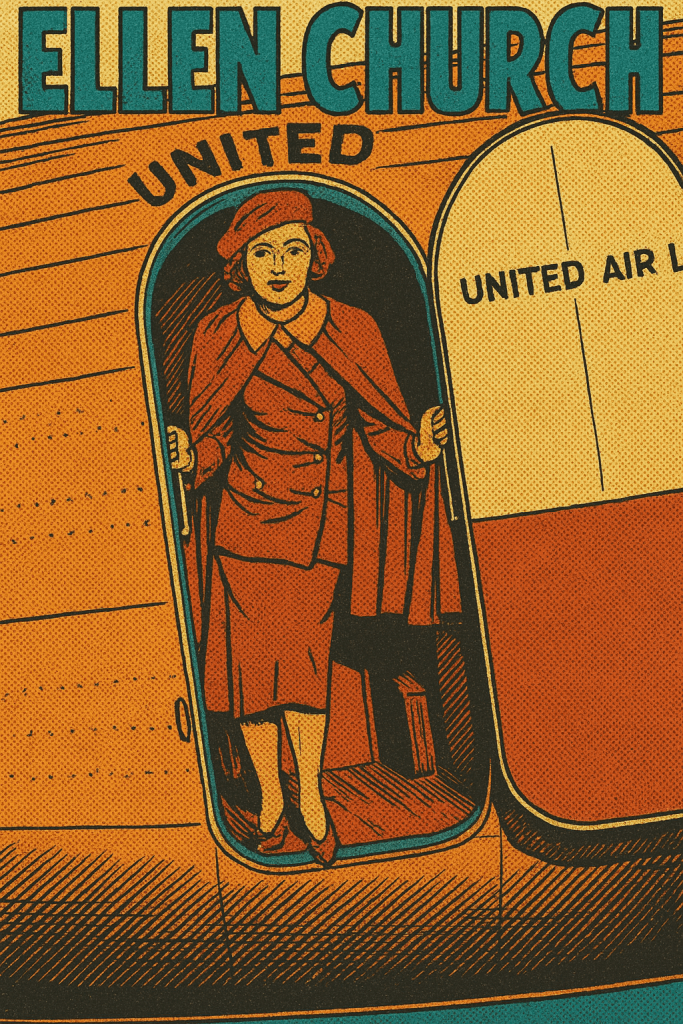
Shivering in the cool, damp San Francisco morning air, Ellen moved deliberately as she helped fuel the aircraft. Known for rotating through all four seasons in a single day, the Bay Area’s early spring chill stung her exposed face and arms.
The frequent fog that often-disrupted airline schedules lingered offshore, giving Ellen Church a clear view of the airport ramp. Her arms ached from the strain of hauling buckets of fuel.

Earlier, she had helped push the aircraft out of the hangar, and now she was assisting the lone mechanic. Only a week into the job, she was already feeling the exhaustion of the long hours.
“You okay to fill one more bucket, Miss Church?” the mechanic asked as he took the fuel bucket from her.
Ellen offered a weary smile, nodded toward the aircraft, and said, “How much does this old girl drink?”
“It’s a good thing she doesn’t have a liver!” he chuckled, quickly turning back to continue fueling the airliner.
She grinned and shook her head. “I’ll be right back.” Though her body was weary, she relished being around the airplanes. Her thoughts drifted back to her childhood in Iowa, where she loved watching pilots train near her family farm.
They were preparing for war, but she was captivated by the sight of elegant planes soaring through the sky. These brave pilots would soon face the devastation of World War I, yet all she saw was a dream—a longing to fly.
Not until she reached adulthood did she have her first opportunity to fly. Upon arriving in San Francisco for a nursing job, she discovered a small airfield and eagerly inquired about flying lessons. In the 1930s, aviation was still finding its footing. Charles Lindbergh’s solo transatlantic flight was only a few years past, Amelia Earhart was making headlines, and air travel—though increasingly viable—remained a novelty, often considered dangerous and wildly expensive.
At airports across the country, aviation was becoming more organized. In 1930, Boeing Air Transport (BAT), part of what would eventually become United Airlines, was among several companies helping to create a national system of commercial air routes. But with crude radio navigation and weather prediction still in their infancy, flying remained perilous—especially over the Rockies or through fog-drenched coastal regions like San Francisco.
At such airfields, many pilots were initially skeptical when a woman expressed interest in flying, yet a few put aside their doubts to help Ellen pursue her dream.
A splash of fuel in her bucket brought her back from fond memories. She glanced down to ensure the precious fuel had landed in its intended spot, then turned her gaze back to the Boeing Model 80.
In an era when most aircraft featured open cockpits, the Model 80 boasted a fully enclosed cockpit and cabin designed with passenger comfort in mind—an aeronautical beauty. Its fuselage was constructed from welded steel tubing, and its wooden wings were designed to fold neatly into small hangars. As a taildragger, its nose was angled skyward, and the elegant airliner always appeared to yearn for flight.

It was one of the first aircraft specifically designed for passenger service, a response to the growing demand for air travel and a sign of the industry’s shift from mail to people. The Model 80 could carry 12 passengers in relative comfort—quite a feat compared to earlier aircraft cobbled together from surplus warplanes.
Ellen quickly returned to the airplane and handed the bucket of fuel to the mechanic. “You good? I need to prep the cabin before passengers arrive,” she said.
The mechanic, absorbed in his work, offered a quick smile and a thumbs-up.
With the fueling complete, she swiftly climbed aboard the airliner and grabbed a small broom. As part of her preflight duties, she swept the cabin, moving the broom between seats. A smile crossed her face as memories of the beginning of her adventure filled her thoughts.
While strolling down a street in San Francisco, she had stopped by the BAT office to inquire about airfares. There, she introduced herself to the gentleman behind the counter.
Steve Stimpson greeted her warmly. After a brief conversation, he was impressed by her aeronautical knowledge and her eagerness to work aboard airplanes. When he learned that she was a nurse, his interest grew even more.
Recalling his days on a steamship, Stimpson had long believed that a steward could be an asset on airplanes, though he had never acted on the idea. He also felt that a nurse could provide valuable services to passengers while easing their nerves—particularly since early commercial flights were loud, bumpy, and anxiety-inducing for the average traveler.
Shortly after speaking with Miss Church, he pitched the idea of hiring nurses to accompany each flight to BAT leadership—only to promptly receive a terse telegram that read, “No!”
Fortunately for Ellen and the fledgling airline industry, William Patterson, the assistant to the company’s President, became involved. Although he was initially skeptical of Stimpson’s idea, some encouragement from his wife convinced him to persuade the airline’s leadership to test the concept.
“You okay?” a friendly voice interrupted her reverie. Ellen had been staring blankly into space, lost in thought about how she had ended up in this job.
“Huh? Yeah, I’m sorry… I think the long days are catching up with me.”
The First Officer smiled from the cockpit. “I know what you mean; however, I’m sticking to one cup of coffee—otherwise, I’d spend more time in the lavatory than in the cockpit. My bladder appreciates it, though my heavy eyelids might disagree.” He chuckled.
She laughed. “If I have time at one of the stops, I’ll brew some extra so we can share a thermos.”
“I’d like that,” he said. “But no worries if you don’t have time—I’m just glad you took over serving sandwiches.”
Before nurses accompanied pilots, the First Officer was responsible for providing box lunches and coffee for passengers—duties that now fell to her.
She smiled. “I’m happy to help.” Then she put the broom away and continued with her other preflight tasks.
After adjusting the lampshades, she knelt and began tightening the floor bolts into which the passenger seats snapped. Her arms had finally recovered from carrying buckets of fuel, but her knees now ached as she moved from one seat to the next. She grimaced and whispered to herself, “$125 a month seemed good when I got this gig, but now I’m starting to wonder… no wonder so many families didn’t approve of their daughters taking this job.”
Finding young women for this new airline career proved challenging. In the short time that she and Stimpson assembled a team of nurses, they managed to hire only four in San Francisco. They then rushed Ellen to Chicago, where she successfully hired another four.
The four nurses recruited in Chicago flew the Eastern Division between Cheyenne and Chicago, while the others covered the Western Division from Cheyenne to San Francisco.
Because of the tight confines of the Model 80 and the need to reduce weight, the nurses had to be no taller than 5’10” and weigh between 115 and 135 pounds. The airline preferred that they be unmarried, hold a college degree, and be both petite and pretty.
She stood, brushed off her knees, and sat in the nearest seat. With passengers arriving soon, she pulled out a small card containing a few notes she intended to share with them.
After a week of flying, she learned several lessons. First, remind passengers not to throw trash out the windows—a recent flight had nearly killed an innocent bystander when someone chucked a bottle out. (The Model 80’s windows could be opened by passengers.) Second, she needed to ensure that passengers were escorted to the lavatory. The Model 80 featured two similar doors at the aft of the aircraft—one leading to the lavatory and the other serving as the main cabin door. Although no one had fallen from the airplane yet, if someone thought it acceptable to toss a bottle out, it was only a matter of time before someone mistakenly used the wrong door.
“Miss Church! Passengers are walking onto the ramp,” the captain called.
“Well… here we go,” she thought as she brushed her hands across her jacket. In roughly 20 hours, she would be in Chicago. She stood, straightened her dress, stepped out of the airplane, and smiled as her first passengers approached.
Little did she know, she was walking into history. At a time when air travel was just beginning to capture the public’s imagination, Ellen Church’s friendly smile and capable hands became a beacon for what commercial flight could become. She never dreamed of being a pioneer, yet here she was, forging a new career in an industry defined by courage, innovation, and skyward ambition.
Ellen Church had embraced her new role as the first Stewardess—what we would now call a Flight Attendant—and in doing so, helped change the face of aviation forever.
 Crock’s Thoughts