China has thrown a curve ball in the stealth fighter arena with its latest iteration of the Chengdu J-20—the J-20S, which is a two-seat variant of China’s premiere fifth-generation fighter.
In a world of unmanned wingmen, AI copilots, and jets that practically file their own taxes, China decided to toss a second human into the cockpit. Why? Well, we’re not sure, but here are a few thoughts…
What Does the “S” Stand For?
The “S” in J-20S probably doesn’t stand for “scoot over,” but it might as well. Officially, it denotes “Shuang,” the Mandarin word for “double” or “twin,” referencing the dual-seat configuration. Unofficially, it could stand for “second opinion”—for when the pilot says, “Hold my beer!”
Two Seats in a Stealth Jet— Why?
In modern U.S. stealth jets like the F-22 Raptor or F-35 Lightning II, it’s all about sleek, single-seat simplicity. Advanced avionics and fusion sensors do the heavy lifting so the pilot can focus on flying and crushing egos at Mach 1.8.
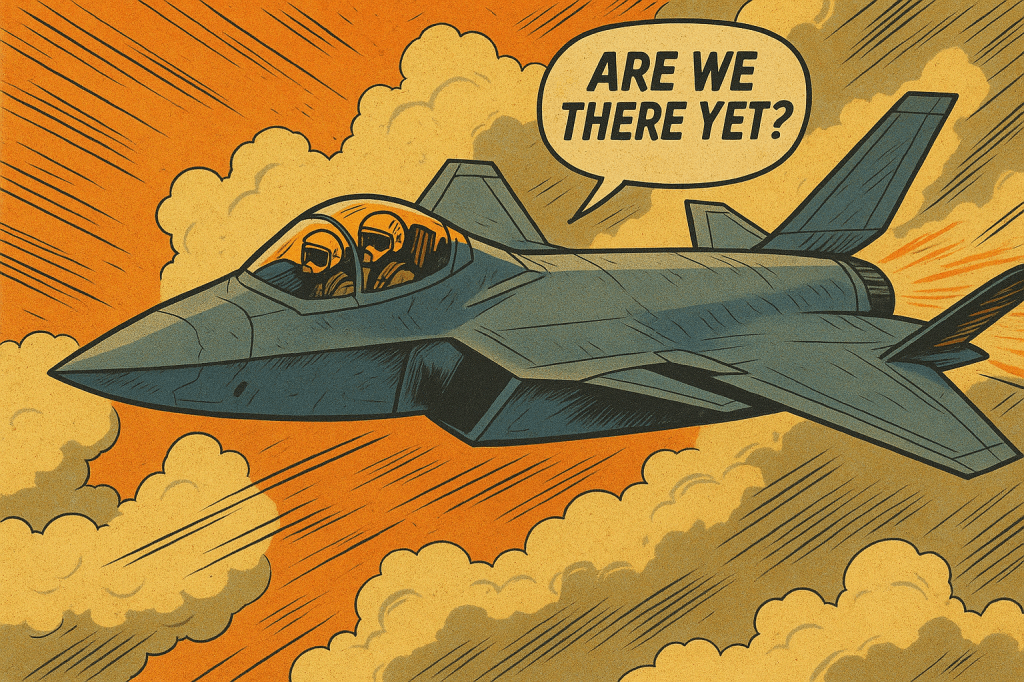
But China went the other direction with the J-20S—and it’s the only known two-seat stealth fighter in the world. The rationale? Well, that second seat could be used for any of the following:
- Training, which makes sense—flying a stealth fighter isn’t exactly like logging time in Microsoft Flight Simulator. However, there’s no evidence it’ll be used for this task.
- Mission command, especially for managing Loyal Wingman-style drones—again, only guessing.
- Electronic warfare or reconnaissance, offloading complex tasks to a dedicated crewmember who doesn’t have to worry about not dying every five seconds—this is the most likely of the three reasons for the second seat.
Is Two Better Than One… or Just Double the Trouble?
The U.S. is betting big on tech—and China is not far behind—particularly with Loyal Wingman drone projects. These AI-controlled or semi-autonomous unmanned aircraft are designed to fly alongside manned jets, acting as scouts, decoys, missile trucks, or even sacrificial lambs if the going gets tough.
So while the J-20S might be able to control drones through a human operator, the U.S. approach is more of “Why train a second pilot when we can just program Skynet-lite and call it a day?”
Pros of the J-20S Second Seat:
- Human flexibility and adaptability in complex, dynamic missions.
- Redundancy and teamwork—always a plus in combat.
- Expanded mission roles (e.g., drone command).
Cons:
- Higher weight and drag.
- Compromised stealth profile.
- More training, more logistics, more coffee needed for briefings.
Final Approach: Human or Hardware?
Whether the J-20S is a clever adaptation or a compromise remains to be seen. It could offer China valuable flexibility for multi-role missions and provide a stepping stone to future manned-unmanned teaming. Or it could be the aviation version of installing a second driver’s seat in a Tesla—interesting, but not exactly the future.
In the end, it’s not just about the number of pilots. It’s about how well your aircraft, systems, and doctrine work together in the chaos of battle. One pilot with great AI can beat two who are arguing over what the radar blip means.
It’ll be interesting to see where this all leads. In a world racing towards more drones and AI, China is keeping backseaters employed. Somewhere, Goose is smiling.
 Crock’s Thoughts